
I first have to apologize that in a previous post, we reported our first visit to the Buchanan Antiques Market, which we just found out was actually Continental Show on the same weekend. We learned this from our yesterday’s visit to the real Buchanan Market, a monthly event held in either the Market Hall or the Fair Park of Dallas.
We were at first dubious at the cashier as the show seemed to offer anything from antiques, collectibles or just stuff you see in a typical flea market. But we warmed up quickly by spotting some interesting items: some stereoview cards of Pittsburgh steel mills (yes, hell without a lid off in 3D), a group of paintings by Jesse Rasberry, and some B&W photos taken by unknown persons.
The most fascinating stop is at a booth with some early Fort Worth photographs from the W.D. Smith estate. Thanks to smartphone technology, we could learn onsite by both looking at real photos and searching for information on the internet on the fly.
W.D. Smith opened the city’s first commercial photography studio in Fort Worth in 1927 and with his son, Gordon Smith, made numerous commercial photographs. When viewed individually, these photos are mostly strictly objective, as the article on the UTA website mentioned that Mr. Smith possessed a rare ability to keep a correct vertical perspective when capturing the image of tall buildings, thus making perfect pictorial documents of architecture. However, when the collection of 190,000 negatives of Fort Worth and North Texas photos, spanning more than seven decades (most of them are now housed in the University of Texas at Arlington where Gordon went to college) is to be viewed collectively, the physical evidence of the past becomes sentimental and nostalgic.

My pursuit of picturesque Texas has so far been futile in the DFW region, as one of my colleagues from Princeton NJ once commented: People come here not for the sake of landscape. Nor would I expect a spectacular collection of architectural gems or decorative art from Fort Worth (Henry du Pont would probably simply take no notice of furniture making here as the city was only established in the 1840s), but just like important historical cities in the Northeast, the city has gone rapid changes before the notion of historical preservation began to examine the remaining architectural integrity. Any piece of document of the city’s past that would otherwise only exist in memory, even though merely half a century ago, becomes interesting to behold and perhaps to collect. In the word of the Mayor of Grapevine, Texas (which has an even longer history than Fort Worth), ““Millions of stories are gone forever, but it is not too late to capture what remains.”
Such is the case of the Carnegie Library of Fort Worth. Fort Worth, which did not previously have a public library, received a Carnegie grant of $50,000 on June 30, 1899. The library with its granite columns and neo-classical facade opened in 1901, but only to be demolished in 1937 for its lack of space. Smith’s photo of the long-gone library is not sentimental, but it is a testament to foresighted urban planning. The new library, on the site of the original library, was opened two years later in 1939 and was also replaced, by another central library building in the 1970s, which is still in use today. Ironically, its design is in resemblance to the original Carnegie Library.
I have always thought the negative film is more collectible than the actual proof until I saw three examples offered in the market. All three are non-typical pictorial photos that UTA is currently holding. In fact, they are the actual pieces entered for some photograph exhibitions of the 40s and 50s. The dealer told me these photos are directly from Smith’s estate, perhaps indicating that the family had held them with intimacy.
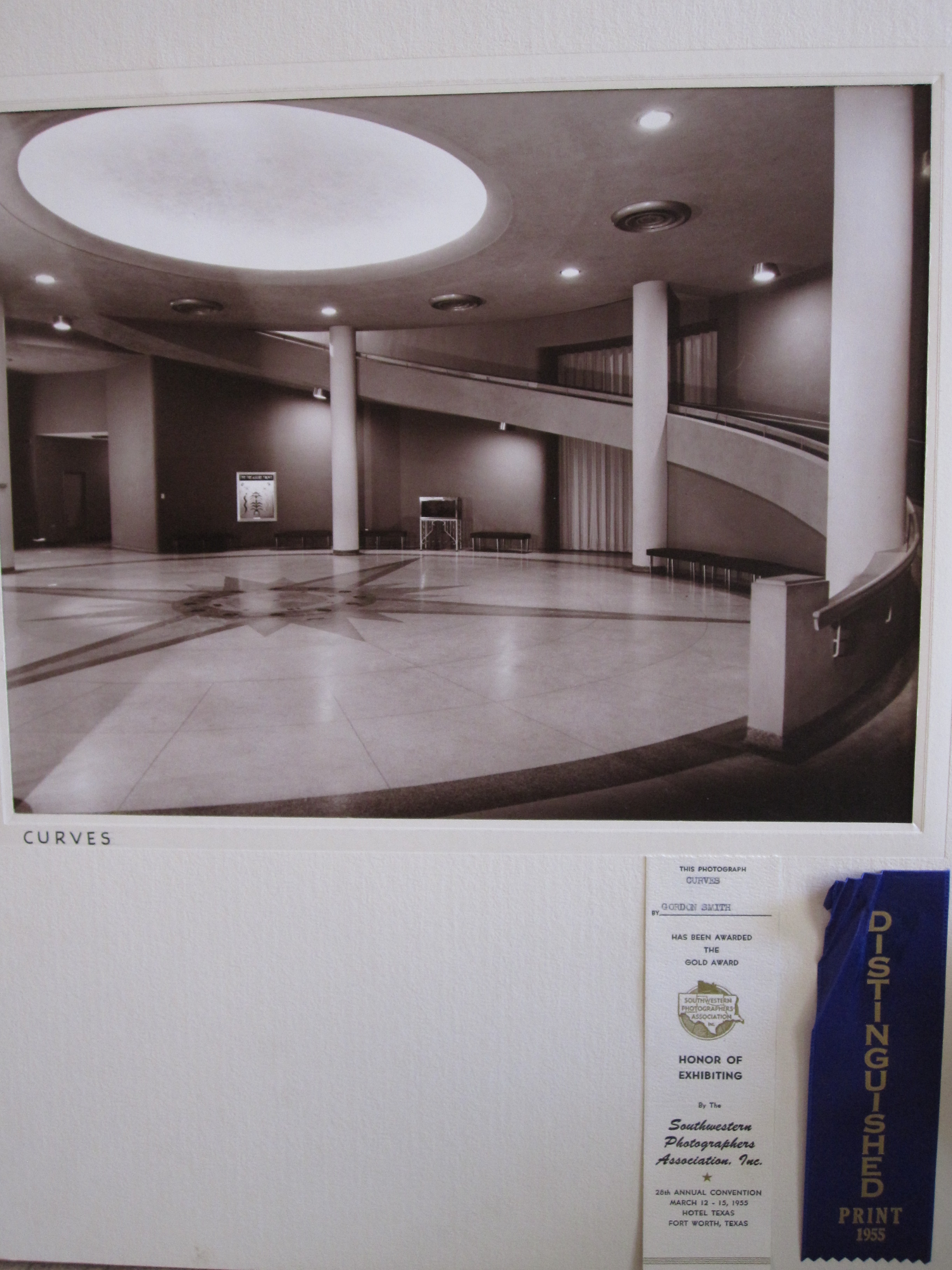
One of three photos is titled “Curve” by Gordon Smith, with not only the Smith Photographs label on the back but also the Gold Award label from the 28th Annual Convention of the Southwestern Photographer’s Association in 1955. I have not found the exact location of this hall interior but would guess it may be the original Charlie Mary Noble Planetarium interior which was completed within one year before the photo was taken. Although I have never been to the Fort Worth Museum of Science and History, a quick search showed a recent upgrade on the building, indicating that maybe this is another photograph of the past.
The second one by his father W.D. Smith was the exhibition piece for the 1948 Photographer’s Association of America Convention. Here Smith took an interest in the area that he had been familiar with and was known for but re-invented as a new concept. “Rebuilt Carburetor” is making both an aesthetic and a philosophical statement. The texture, tonality, and forms of this complicated device are intriguingly beautiful, something we overlook and have been overlooking. We drive the car to Yosemite or Yellowstone, yet would never be thought of as the oily, clumsy, and noisy engine containing anything eye-soothing. By bringing up a close-up, near pornographic-style shot of a carburetor, a thing that we use daily without even a single look, Smith pushed us to examine, beyond its functionality, what a mechanic device is with respect to its shape, volume, and its integral visual impact.
On the other hand, Smith Photograph Company had been doing commercial photography for all kinds of businesses: refineries, trains, car dealerships, or construction. Here instead of taking in a brand name that we would associate with a certain type of commercialism, he selected a rebuilt carburetor. It functions the same as a brand-new one and would potentially fit in certain engines. But when a rebuilt carburetor is placed on a piece of white foam board with delicate lighting, how do we perceive it differently as fine art instead of commercial art? Geo commented there is a certain kind of momentum in it even though it is a still-life snapshot. That is quite a statement.

The last of the three is a photo of an engraver at work. The overall dark tone has a humane warmth that connects the viewer with the engraver who paid no attention to the outside world. His right arm is slightly out of focus, perhaps because of the movement, yet his gesture has a definite monumentality that draws the viewer into his mind and action.
I saw the image as a reinforced notion of the lost artisanship and an elegy of our waning determination of utilizing our skill, intuition, and fortitude in pursuit of precision and perfection against all unforeseen odds. Except in the small artistic field, both engraving and B&W film photography have been abandoned nowadays. The workmanship acquired in a year-long apprenticeship has given in to fast-food types of techniques based on computer software that is easier to hone and more fault-tolerant. That reminds me of the recent news that Kodak has stopped making Kodachrome. The famed photographer Steve McCurry commented in the end, “Imagine leaving digital images in a hard drive and coming back 40 years later. Would anybody be able to read that data? That’s the great thing about the film. It’s a self-contained object. You hold the picture up to the light and there it is.“



Leave a Reply